Directory

Showing posts with label Marine Creatures I.D.. Show all posts

Thursday, 13 December 2012

Introduction

Welcome to our blog, Kimmode123. We are the Kim Mode Team. Here we will post about the marine organisms we have seen during our various field trips. All creatures featured on this blog have been spotted and seen personally by us. Also included are our reflections of the field trips, and the pictures we have taken. Pictures NOT taken by us have been labeled with (R) to indicate that the picture is taken from one of our sources. All sources and references are included at the end of each post. 

We have done our best to identify as any marine creatures as possible(more than 40), and classified most of them into the posts "Mangroves!!","Echinoderms","Arthropods" and "Fishes".  The link Gallery will take you to our reflections posts, while "Marine Creatures I.D." will take you to other posts.

With gratitude for your time, 
The Kim Mode team.

Tuesday, 6 November 2012

Fishes


Arapaima

Scientific classification
Kingdom: Animalia
Phylum: Chordata
Class: Actinopterygii
Order: Osteoglossiformes
Family: Osteoglossidae
Subfamily: Heterotidinae
Genus: Arapaima
Species: A. gigas

The arapaima originates from South America. It is a living fossil (Living fossils are organisms that have remained essentially unchanged from earlier geologic times and whole close relatives are usually extinct or has none). The tropical freshwater fish is among the largest freshwater in the world, reaching lengths of more than 2m and weighing over 100kg.

Arapaima feeds on fish, crustaceans and small animals walking on the shore, a predatory fish. They prefer hunting close to the surface, as this allows them to catch the small animals, as well as breathe in air. They have labyrinth organ, a much-folded suprabranchial accessory breathing organ rich in blood vessels and open into the fish’s mouth, making it an air-breather too. This makes them able to survive in the Amazon River (where they live wild) which has oxygen-deprived water.

Arapaima reproduces by spawning. Their life cycle is hugely affected by the geographic range that they inhabit in, by the seasonal flooding that occurs. Arapaima lay their eggs when water levels are low, and build a nest in muddy bottomed areas. The water rises then eggs hatch, offspring can grow well during flood season. The male is a mouthbrooder, it keeps the young protected in its mouth until they are old enough. The female protects the male and the young by fending off predators.

Arapaima plays an important role to humans. They are often fished as a food source, as they are huge and have little bone in the meat. Since arapaima needs to swim up to the surface to breathe air, they are often harpooned and clubbed dead. With a body meat percentage of more than 50, they can yield up to 70kg of meat per fish. Their meat are said to be delicious, making them widely fished for. They are also used as aquarium fish, and much special care is needed as they are gigantic. Large space and resources are needed to keep them. Their tongue supposedly has medicinal values in South America, and is mixed with other medicinal products which are able to kill intestinal worms.

However, due to humans over harvesting of arapaima from the wild, their quantities have dropped severely over the years. It is not endangered, but it is becoming rare. It is a good thing to see Brazilian government taking actions by banning commercial fishing, but people still do it illegally. As people begin to control their excess harvest, we would (hopefully) be able to see them in the future.


White and Black tipped Reef Shark
Black-tipped Reef Shark
                                                                                     
White-tipped Reef Shark

The white and black tipped reef sharks are easily recognisable due to the tell-tale white and black tips of their dorsal fins. They are relatively small sharks that grow on average not more than 2.0m. They are saltwater sharks and can be found mostly amongst the reefs where they hunt at night. Their hard protective scales provide protection when they squirm in between coral to catch fish hiding inside.
They must consistently swim to breathe because by doing so , the movement of water through the gills is the only way through which the shark can breathe.


African Lungfish

Sign in Underwater World, Sentosa Singapore

  The African Lungfish is a species of Lungfish that is found unique to Africa. Their largest species reach to about 200cm in length. Because they live in an environment where oxygenated water is a rarity, lungfishes have developed a unique adaptation to counter that problem. They have developed a 'lung' which is directly connected to the alimentary canal. This 'lung' is used for breathing. It is actually a specialized version of the swim bladder.
  The African Lungfish has totally no gill at all and relies solely on its lungs for gaseous exchange.
Body of a Lungfish


  The African Lungfish is a carnivorous animal that usually feeds on crustaceans and molluscs.


Goby


Goby, one of the largest family fish, are commonly found in tropical and temperate regions around the world, and commonly on many of Singapore’s shores. They are among the smallest vertebrates in the world, and camouflage well with sand and mud. Being shy creatures, they and hide into holes or rocks at the slightest sign of danger, making them very difficult to spot.

They usually dwell in the bottom of the seas, feeding on very small creatures like planktons, or filter micro-organisms from the sand. Despite being fast when hiding, they are mostly not very fast swimmers, with missing swim bladder and having cylindrical body shape, instead of streamlined body shapes. They also rely on fins to grasp tightly on surfaces, like a suction pad. Great camouflage and large eyes high up on the head help them in spotting and avoiding predators.

Gobies are vital in the good chain, serving as primary (sometimes secondary) consumers. They have been important indicators on whether a marine ecosystem is under threat, as many of them would disappear if an ecosystem is unstable. Also, they make up about half of a marine life, without them other species would be gone soon.

Due to their relatively simple caring and huge quantities, they have been kept as pets in aquariums often.


Ikan Ubi or True Goby
References: hasnulyakin.blogspot.com


      One interesting symbiotic interaction of a Goby that we witnessed on our trip to Pulau Hantu, was the interaction between the Sand Goby and the Snapping Shrimp. The Snapping Shrimp digs a burrow in the ground where it lives. It 'employs' a Goby to keep watch at its entrance whenever it is at home. Since the Snapping Shrimp is near blind, it requires the Goby as its eyes. Therefore, whenever a predator approaches, the Goby would rush into the burrow dug by the Snapping Shrimp thus giving the shrimp a sign that it too must hide for danger is approaching. It is able to detect the movements of the goby by placing one of its antenna on the goby's body.
       Therefore, the Snapping Shrimp gets shelter and the Snapping Shrimp gets protection form oncoming danger.


Sorry for sideways picture. Goby is circled out.


Lion Fish at Underwater World Sentosa,Singapore
Lion Fish
Lion Fishes are easily recognizable by their venomous fins that it shows off to ward away would-be predators. These small fish rarely grow to over half a metre in length. They can mostly be found in reefs in the Altantic Ocean where they may have been unintentionally introduced. Lion fish usually feed on smaller fish although their diet does included molluscs.


hasnulyakin.blogspot.com
http://en.wikipedia.org/wiki/Arapaima
http://en.wikipedia.org/wiki/Protopterus

Friday, 17 August 2012

Sungei Buloh

Your image is loading...
monintors, birds nest

Your image is loading...
trees

Your image is loading...
bird and bats

Pulau Semakau

Your image is loading...
sponges, anemone , hairy crabs

Your image is loading...
corals and shells

Your image is loading...
sponges, snails, shells, octopi

Your image is loading...
shrimp, shell and seastar

Your image is loading...
flatworm, seahorse and clam

Your image is loading...
more corals and a nudibranch

Your image is loading...
hairy crabs, sponges, marine spider

Your image is loading...

sea cucumbers, crabs, crab holes

landfill facilities

Thursday, 16 August 2012

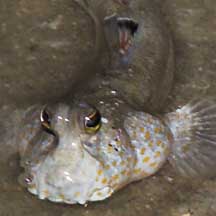
Mudskippers (Family Gobiidae)

Yellow spotted mudskipper on Kusu Island

Scientific classification
Kingdom:Animalia
Phylum:Chordata
Superclass:Osteichthyes
Class:Actinopterygii
Superorder:Acanthopterygii
Order:Perciformes
Suborder:Gobioidei
Family:Gobiidae
Subfamily:Oxudercinae
 Mudskippers are commonly seen on many of our shores. They are particularly abundant in mangroves and muddy shores, but are also seen on rocky shores and near reefs.Mudskippers are well adapted to the intertidal area. Being able to stay of water for a while gives mudskippers an advantage over 'normal' fishes. During low tide, they are among the few marine creatures that can exploit the dry muddy or sandy flats.While out of water, they breathe by retaining water in enlarged gill chambers.They can also breathe air through their wet skin. These fish are in fact more comfortable crawling around on the mud than submerged in water! They curl their muscular body sideways then push against the mud to spring forward.


Tuesday, 14 August 2012

Creeper snails (Family Certhiidae)

Scientific Classification

Kingdom: Animalia
Phylum: Mollusca
Class: Gastropoda
Family: Certhiidae

Creeper snails are commonly found on Singapore's shores, but often overlooked due to being well-camouflauged shells. They can be found on sandy shores, coral rubble and many coral reefs, and usually in groups or individually. They feed on algae and detritus of sea bottom, usually near reefs.

Creeper snails are small in length, around 2.5cm in length. They have narrow and long spiraled shell, with an upturned siphonal canal at the opening. The snail hides just beneath the sand, protecting the siphon. Horny materials, usually brown, makes the operculum of the shell.

Their tiny shell is usually used by young hermit crabs (once the snails die) as hermit crab's first home, as the shell would be hollow and just nice for new hermit crabs. Their shells have also been collected by hobbyists or for shell trade, as some of them may be rather attractive.
Some species of creeper snails, such as the Cerithium trailli, is listed "Endangered" on the red list of animals threatened of Singapore. The shores they used to be found has been lost from reclamation. Many creeper snails are in danger from being endangered due to human activities like reclamation and pollution. They have also been trampled on by careless visitors on shores, and extreme collection would reduce their numbers greatly too.

Top Shell ( family Trochidae)

They are shells of marine snails of the family Trochidae (subclass Prosobranchia, class Gastropoda), having a spiral, conical shell. They are found from the intertidal zone to the deep open seas, with greatest diversity in shallow waters along rocky shores of the equator to high latitudes. Tropical top shells tend to be larger and more colourful than from other regions such as the Atlantic shores or the Pacific. All species are herbivorous, feeding on algae or films of spores on rock surfaces. Males and females are in separate individuals, and fertilization is external, with most species having free-swimming larva.

The interiors of all top shells are nacreous (Definition of Nacreous: consisting of or resembling mother-of-pearl). This has made them popular among humans usage. For example, the largest species, Trochus niloticus, was once extensively fished for its lustrous mother-of-pearl layer, which was used in the manufacture of pearl buttons.

Friday, 3 August 2012

Flat Worm (Phylum Platyhelminthes)

Flatworm in a container


Flatworms are unsegmented worms with a soft, flat body. Some flatworms live in water, chiefly in the sea, but most are parasites that live in the bodies of other animals. Parasitic flatworms are called flukes and tapeworms. The most common freshwater-dwelling flatworm is the planarian.
The flatworm is the lowest animal with a head, a centralized nervous system, complex reproductive organs, a mesoderm, and a bilaterally symmetrical body. (The mesoderm is the middle layer of embryonic cells, from which muscles and other tissues develop. A bilaterally symmetrical body is one in which the right and left halves are almost identical in shape and size.)
Flatworms move by undulating their sides in a wavelike pattern.

Thursday, 2 August 2012

Sea Grapes (Caulerpa lentillifera)


Sea Grapes(C. racemosa) are actually a type of green algae so named for their resemblence to grapes.It occurs from shallow muddy bays to clear water reef environments, at depths from near the surface to 100 m. It can occur adjacent to living corals and has even been observed growing on the coral Acropora palmata . This plant has erect branches arising from a horizontal stolon attached to the sediment at intervals by descending rhizomes. The erect branches arise every few centimeters, reaching as much as 30 cm in height.  Sea grape is also rich in polyunsaturated fatty acid, vitamin B2 & E, and micronutrients Zn, Ca, Mg, Se, Fe, Mn, Co. It is prepared not only as sole fresh salad but also mixed with sea food or meat, deserved high price from the beautiful look, delicious taste and nutritive value.

C. racemosa reproduces vegetatively mainly by fragmentation. When pieces of the plant get broken off they develop into new plants. Small pieces of tissue only a few millimetres across are capable of doing this.

C. racemosa can also reproduce sexually and in so doing exhibits holocarpy. This means that all the organism's cytoplasm is used up in the creation of the gametes and only a husk remains at the site of the original plant. The plants are monoecious with male and female gametes being produced by the same plant and liberated into the water column where they unite to give spherical zygotes.

ref: http://species-identification.org/species.php?species_group=caribbean_diving_guide&id=489
http://flora.coa.gov.tw/view_eng.php?id=322

Wednesday, 1 August 2012

Tuesday, 31 July 2012

Pests! Sandflies

Sandflies!!!

We all hate them more than mosquitoes. Everybody knows what mosquitoes bite us for, and what can they do and spread etc. Sandflies got to be much worse by a mile.

They are so tiny, and so hard to find. They aren't as sloppy as mosquitoes, they fly pretty fast. Also, they love to disturb us when we're on our walks. Also, one little bite would only begin to feel the itch after few hours or a day later, and it would really itch very badly.

The term "sandfly" is applied to a wide range of species which are those biting critters. Being in Order Dipteria, they are generally true flies, including mosquitoes and houseflies. They are very much like female mosquitoes, biting us for the blood needed to produce eggs. Mosquitoes can spread diseases such as malaria and dengue, and sandflies can transmit leishmaniasis, a potentially lethal disease.

A good way to deal with bites is to not get bitten by these. Best, avoid the shore or damp places, or really do apply insect repellent. Long pants, long sleeves would help very well. If bitten, scratching would cause your skin to get itchier, bleed and infected, and still itchy. Leave it to heal naturally and not to scratch it would probably be the best method. Google is an alternative source of solutions too.

Well, just take care of yourself.

Sand Collar of (family Naticidae)


Sand collars are the egg masses of certain sea snails, marine gastropod mollusks in the family, sometimes known as "moon snails".

These egg masses often wash up on sandy beaches, either whole or sometimes in fragments. When they are whole, sand collars are shaped like an old-fashioned detachable shirt or blouse collar (hence the name). They consist of sand grains cemented together by a gelatinous matrix, with embedded eggs.

A fresh sand collar feels stiff and yet flexible, as if it were made out of plastic. Each sand collar contains thousands of capsules, each one housing one or several live embryos. After the eggs hatch, the sand collar disintegrates.


http://en.wikipedia.org/wiki/Sand_collar

Yellow-lipped Sea Krait (Laticauda colubrina)

Yellow lipped sea krait

Yellow-lipped Sea Krait  is a species of sea snake found in tropical Indo-Pacific oceanic waters. The colubrine sea kraitbanded sea krait or yellow-lipped sea krait (Laticauda colubrina) is a species of sea snake found in tropical Indo-Pacificoceanic waters.Banded sea kraits are often seen in large numbers in the company of hunting parties of giant trevally (Caranx ignobilis) and goatfish. Their cooperative hunting technique is similar to that of the moray eel, with the kraits flushing out prey from narrow crevices and holes. Kraits need to drink fresh water and regularly come onto land for that purpose. These snakes can be distinguished by their yellow markings on their snout and the black bands  throughout their belly. 


This video is zoomed as the snake is not approachable
ref: http://en.wikipedia.org/wiki/Laticauda_colubrina

Wednesday, 25 July 2012

Spongy Sponges


Sponges are the simplest of animals. They are classified as animals because they are multicellular, heterotrophic, and lack cell walls. They lack true tissues and organs, and have internal skeletons of spongin or calcium  carbonate, consisting of jelly-like mesophyl sandwiched between two thin layers of cells.  Sponges have no body symmetry, rather, the shapes of the bodies of sponges are adapted for maximal efficiency of water flow. Water enters through the central cavity, deposits nutrients, and leaves through a hole called the osculum. All sponges are sessile(multi-celled animals) aquatic animals, and do not have nervous,circulatory or digestive systems. Instead, most rely on maintaining a constant water flow through their bodies to obtain food, oxygen and remove wastes.

While most of the approximately 5,000–10,000 known species feed on bacteria and other food particles in the ocean, some host photosynthesizing micro-organisms known  as endosymbionts and these symbiotic relationships often produce more food and oxygen than they consume. A few species of sponge that live in food-poor environments have become carnivores that prey mainly on small crustaceans.

Sponges are hermaphrodites and reproduce mostly by sexual reproduction, releasing sperm cells into the ocean to fertilize ova that in some species are released and in others are retained by the "mother". The fertilized eggs form larvae which swim off in search of places to settle. When conditions deteriorate, for example as temperatures drop or salinity decreases, many freshwater species and a few marine ones produce gemmules, "survival pods" of unspecialized cells that remain dormant until conditions improve and then either form completely new sponges or recolonize the skeletons of their parents.

Sponges do not have the complex immune systems of most other animals. However they can reject tissues from other species but accept them from other members of their own species. In a few species, gray cells play the role of lysosomes in rejection of foreign material and microbes. When invaded, they produce a chemical that stops movement of other cells in the affected area, thus preventing the intruder from utilizing the sponge's internal transport systems. If the intrusion persists, the grey cells concentrate in the area and release toxins that kill all cells in the area. The "immune" system can stay in this activated state for up to three weeks.


Dried Sponges

Blue Sponge


ref:en.wikipedia.org/wiki/Sponge

Tuesday, 10 July 2012

Brain Corals (Family Faviidae)


Scientific classification

Kingdom: Animalia

Phylum: Cnidaria

Class: Anthozoa

Order: Scleractinia

Suborder: Faviina

Family: Faviidae

With their steroid shape and grooved surface, these hard corals closely resemble brains. Brain corals secrete a hard skeleton of calcium carbonate (obtained from minerals they get from the ocean water), which makes them important coral reef builders. Brain corals extend their tentacles to catch food at night. During the day, the brain corals use their tentacles for protection by wrapping them over the grooves on their surface. The surface is hard and offers good protection against predators. Like other genera of corals, brain corals feed on small drifting animals. They also receive nutrients provided by the algae which live within their tissues.

They usually live in shallow warm-water coral reefs all over the oceans in the world, with relatively long lifespans of more than 100 years. They can be very colourful, which attracts many divers, as well as fishes as they life permanently on the coral. Fishes include gobies, another interesting marine organism we found at Pulau Semakau.

Nudibranch (Clade Nudibranchia)


Funeral Nudibranch
The Nudibranch, previously classified as a gastropod, is a small shell-less organism often mistaken as a sea slug. Through the course of evolution, Nudibranchs have lost their shells in exchange for defense mechanisms. Several adaptations include mimicking their surroundings for camouflage and the bright coloring of their bodies to warn predators of the distaste of eating them. Nudibranchs usually deploy chemical defense mechanisms to incapacitate their predator thus escaping death. Nudibranchs are known to be poisonous.They have an exposed gill on their backs, which is shaped like a plume or a flower.
   Being slow moving and small, these critters often feed on corals, anemones, sponges and other small, immobile organisms. Many species have a rough tongue(radula) which contain specially adapted "teeth" which aid the Nudibranch in scraping its prey. Some species, however, choose to simply secrete digestive enzymes onto its prey and suck up their remains. We found these specimens at Pulau Semakau landfill in Singapore, hiding in the littoral zone.